Do you need to know how to swim to go canyoning?
From the spring and throughout the summer, we are all on the look-out for original, sporting or extreme activities to occupy our weekends and holidays. Depending on the region of the world or of France, themed activities are on offer to you. Among them is a semi-aquatic activity to be enjoyed just as much with family as with friends: canyoning!
If you are about to go canyoning for the first time, you surely have a few questions in mind, notably: Do you need to know how to swim to go canyoning?
Yes and No 🤗
This sport, which combines climbing and hiking, involves travelling along streams or rivers by walking, climbing, jumping, abseiling or swimming over greater or lesser distances. Canyoning is defined as progressing along the bed of a watercourse. However, in reality, canyoning routes are similar but not identical! Some of them require swimming over long distances or through deep pools, which means participants must be comfortable with swimming. Conversely, there are routes with very little or no water at all, where it is therefore not necessary to know how to swim!
The answer is therefore in two parts: as a general rule, it is necessary to know how to swim, but not always!
Choose the route at your level 💪🏼
At a national level, canyoning routes are catalogued according to certain criteria in order to identify their difficulty. To do this, three criteria are taken into account:
- The descent and gradient stages are denoted by a V: V1 being the routes with the least gradient and therefore the easiest, and V5 indicating the most difficult routes.
- The aquatic aspect of the course is symbolised by the letter A: A1 corresponds to simple water courses with very little depth, and A5 symbolises more complex courses, which notably require swimming underwater for varying lengths of time during certain stages.
- Finally, the E symbol will indicate, over a longer or shorter period (from 30 minutes to 2 hours), how long you can spend isolated, meaning without the possibility of getting help or turning back.
Ultimately, all these criteria result in ratings such as “A1V2E3” which make it possible to identify the various elements of difficulty of the route.
At Hydrogene sports, to make your life easier, we categorise our different routes by colour: green, blue and red (just like on the slopes ⛷) so that you can identify the routes that suit you best.
The Green routes
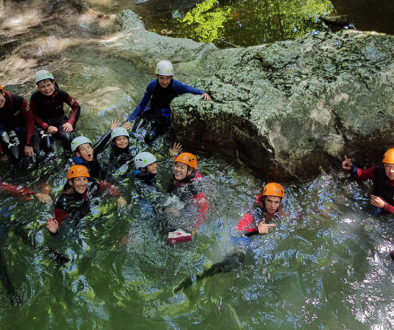
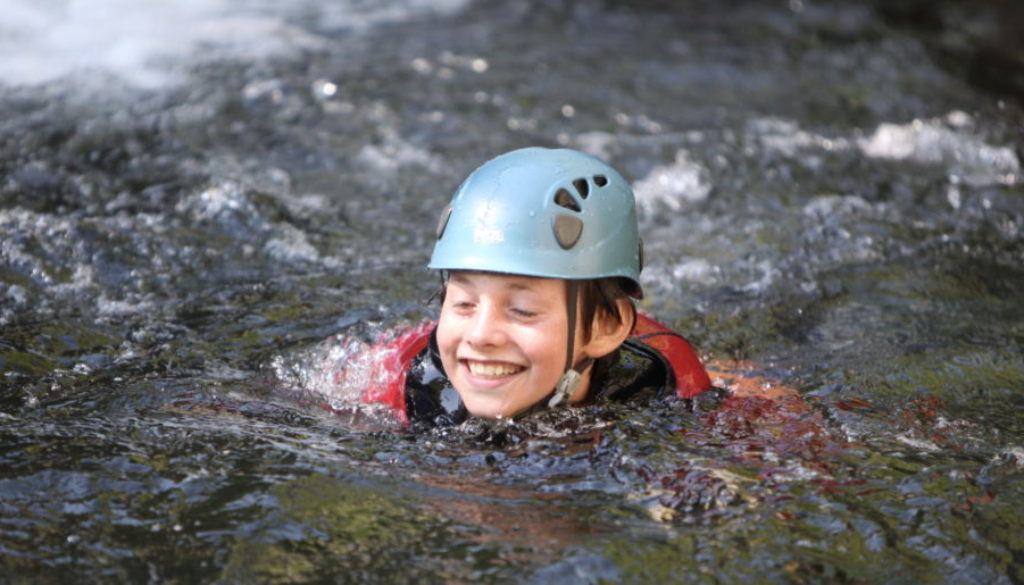
Green routes are accessible to children from the age of 6 and below this age if the child shows a real affinity for the water. These routes do not require the ability to swim, so they are the most suitable to accommodate all family members. Furthermore, the neoprene wetsuits help you to float and you will be able to bypass all the places where you cannot touch the bottom.
Find out more about the Green pathways →
The Blue routes
The blue trails are accessible from the age of 8 with an intermediate level, and are mainly intended for families or beginners. Throughout the trail, we have set up numerous exit points just in case. The blue trails last 1.5 hours for more action, giving you time to enjoy the scenery and in particular one of the most beautiful canyoning routes in Annecy and Aix-les-Bains.
Find out more about the Blue pathways →
The Red routes
To finish, you can opt for the red routes at the Pont du Diable! A real breath of adventure accessible from the age of 12 provided that each participant can swim properly and is not afraid of putting their head underwater. Throughout the route you will have access to numerous jumps, some of which are not compulsory and can be bypassed, but it will be essential that you know how to jump from at least 4 metres high.
Find out more about Red routes →
Finally, if you want to make the most of the activity, choose the route that best suits your skills and always let the instructor know about your swimming ability, as they are there to help you.